Belica, Croatia
Dear .NET dev,
If you would like to architect and build easily scalable and high-performance .NET apps from scratch, even if you get vague project requirements…
…this will be the most important message you'll read today.
Today I want to introduce you to a powerful software architecture method that requires little-to-no creative brain power and previous software architecture experience to use, but enables you to analyze project requirements and confidently choose the right architectural pattern…
…even if you haven't done much software architecture work before,
…even if you have only worked on small or legacy projects so far,
…even if you usually shy away from making architecture calls.
Using the exact approach shown only here, you can:
- Decrypt the vague project requirements and turn them into a clear project design
- Balance and find the right trade-off between system flexibility, scalability, and maintainability when designing complex architectures
- Confidently choose the optimal architecture pattern depending on requirements
- Implement the selected architecture, and structure your solution using industry standards and the latest best practices
- Grow as a software engineer and open up new career opportunities
- Move to an architect role and stay relevant to the current trends.
And all of that without having natural talents, gifts, or previous architecture experience.
I call it the "Architecture Fit Method."
It's not only a very different way of architecting your apps…
But it's also a unique method for analyzing client requirements and translating them to a technical solution.
After 14 years of developing and architecting enterprise .NET projects…
I can tell you I have not seen anything simpler or easier for designing an architecture from scratch.
Sounds interesting?
If so, you're about to understand why The Architecture Fit Method helps me, as well as other developers, help make better architecture decisions and offers practical framework for designing enterprise .NET projects.
So you can deliver better products.
Take, for example, what Pierre said about it:
"For me, it replaced all the abstract theory with a tactical framework for building resilient, scalable architectures."
Or Carlos:
"I was doing architecture work without truly thinking like an architect... making decisions based on experience and hunch rather than a clear methodology.
This fixed that."
Or Raj:
"It provides…
A pathway for you to become, first, a senior developer and, then finally, an architect."
Now, let me be clear:
The Architecture Fit Method wasn't born out of creativity or a light-bulb moment.
It was born out of necessity.
All while working on large enterprise .NET projects.
But before I explain how you can start using The Architecture Fit Method to decide which architecture layers, components, and patterns to use…
Let me quickly introduce myself.
Hi, I'm Kristijan Kralj…

Ever since the early college days, I have been obsessed with software architecture.
In 2011, my team and I developed a ride-sharing application using Azure, Windows Phone 7, and the CSLA .NET framework.
Essentially, we designed Uber before Uber became mainstream.
For the project, we got Rotary and Dean's awards.

Me with the Rotary Award in 2012
After the college, I started working as a .NET developer, then as a team lead.
Being a senior developer, I had to make many architectural decisions, often on an ad hoc basis.
Without having an architect to rely on and ask questions.
Without really knowing if those decisions will survive long-term future changes.
But everything changed in 2022, when I got my first official software architecture task:
To design a notification sub-system inside an established microservices application.
There I was, just a regular senior .NET developer, put in a helm to…
Design a sub-system architecture inside an app that is mostly used by global brands with 10,000+ employees and 200M-1000M dollars in revenue
I was scared.
But my manager convinced me that I could do it.
"Don't worry", she said, "you won't be starting from scratch. We have templates, checklists, and different tools we usually use during this process."
The templates helped.
But I still had to change the way I work.
You see…
Since my previous experience was mainly on legacy projects, there was a mismatch in how my .NET brain operated. And the way it needs to operate to think like an architect.
So I did the only thing I could think of: started researching and learning like crazy.
System design books…
Software architecture books, blogs, and articles…
I studied all that to…
Turn myself from a legacy .NET developer into an architect
I made a lot of mistakes along the way while working on that feature.
But I finally did it.
And got praise from my manager:
"Excellent job btw........ it's a pleasure to read the design doc, and you've absolutely thought of everything.
Your design is literally half the work. When it's laid out like this, development will be much easier."
After that, I designed another feature.
And in the following years, I kept making the software architecture decisions while working on projects of different sizes.
Along the way, I started to assemble, collect, and create resources, cheat sheets, and templates that helped me make better software architecture decisions with more confidence and in less time.
So I could design .NET solutions almost on autopilot in any type or size of the project.
And from that process, the Architecture Fit Method emerged as an easy, fast way to absolutely nail THE most important piece in every software project…
Software architecture.
Get this WRONG… and nothing else can make your project successful long-term
Every successful developer, architect, and engineer knows…
The architecture you pick at the start makes or breaks the success of your entire software development project.
Not the language you choose.
Not the design patterns you use.
Not the libraries you import.
No. None of those.
The architecture.
Poor architecture leads to awful productivity, slow feature delivery, and more bugs.
And…
Top software experts in the industry agree…
For example, the DORA 2025 report from Google states that:
"Teams who worked in loosely coupled architectures and had fast feedback loops experienced productivity gains of 20% to 30%, as measured by increases in commits, pull requests, and overall feature-delivery velocity, and had a 50% increase in 'Happy Time' — more hands-on coding and less administrative toil."
Another study, Kouroshfar et al. From 2015:
"Architecture bad smells (aka poor architecture) has detrimental effects on system architecture properties."
In other words, based on the 7 projects they have researched, poor architectural boundaries and cross-module changes make every change riskier and lead to more bugs (99% confidence interval).
I've never been to Iceland, but a study of 1,141 software projects from the University of Iceland (Hansen, Jónasson & Neukirchen, 2009) found that architecture quality directly predicted defect rates. Poorly architected projects show roughly double the bugs of well-architected ones.
The researchers' conclusion? Getting architecture wrong has a quantifiable cost.
And this is why, when it comes to software development…
Software… architecture… is… EVERYTHING!
Now maybe you're already thinking…
"This sounds great, Kristijan… but it's not for me. I don't want to be an architect or have priceless software architecture skills. I just want to be a developer: write code and be left alone."
I get it.
Not everyone wants to be an architect.
And being just a coder was enough in the past. You get the requirements, make changes, push the task forward, and clock out for the day.
However, like it or not, our profession fundamentally changed in November 2022:
When OpenAI released ChatGPT.
Since ChatGPT, Claude, Gemini, and all other AI tools can produce the code way faster than any human can…
Being just a "Coder" is no longer enough!
Not today…
In 2026…
Not if you are in a competitive or crowded job market.
Being a developer who waits for fleshed-out requirements in a Jira task before starting to code is NO longer a job with a future.
As the AI writes more and more code, that leaves humans…
Aka you and me…
To use our brains and mental power for higher abstraction, more valuable work.
The best developers at Spotify write less code these days.
Heck, I only write 30-40% code manually these days.
And a lot of developers I know code less manually.
There was an article how top developers at Spotify haven't manually written a single line of code since December 2025.

These days, your time goes to planning, analyzing requirements, and translating them and constraints into a solution structure that satisfies both functional and non-functional requirements.
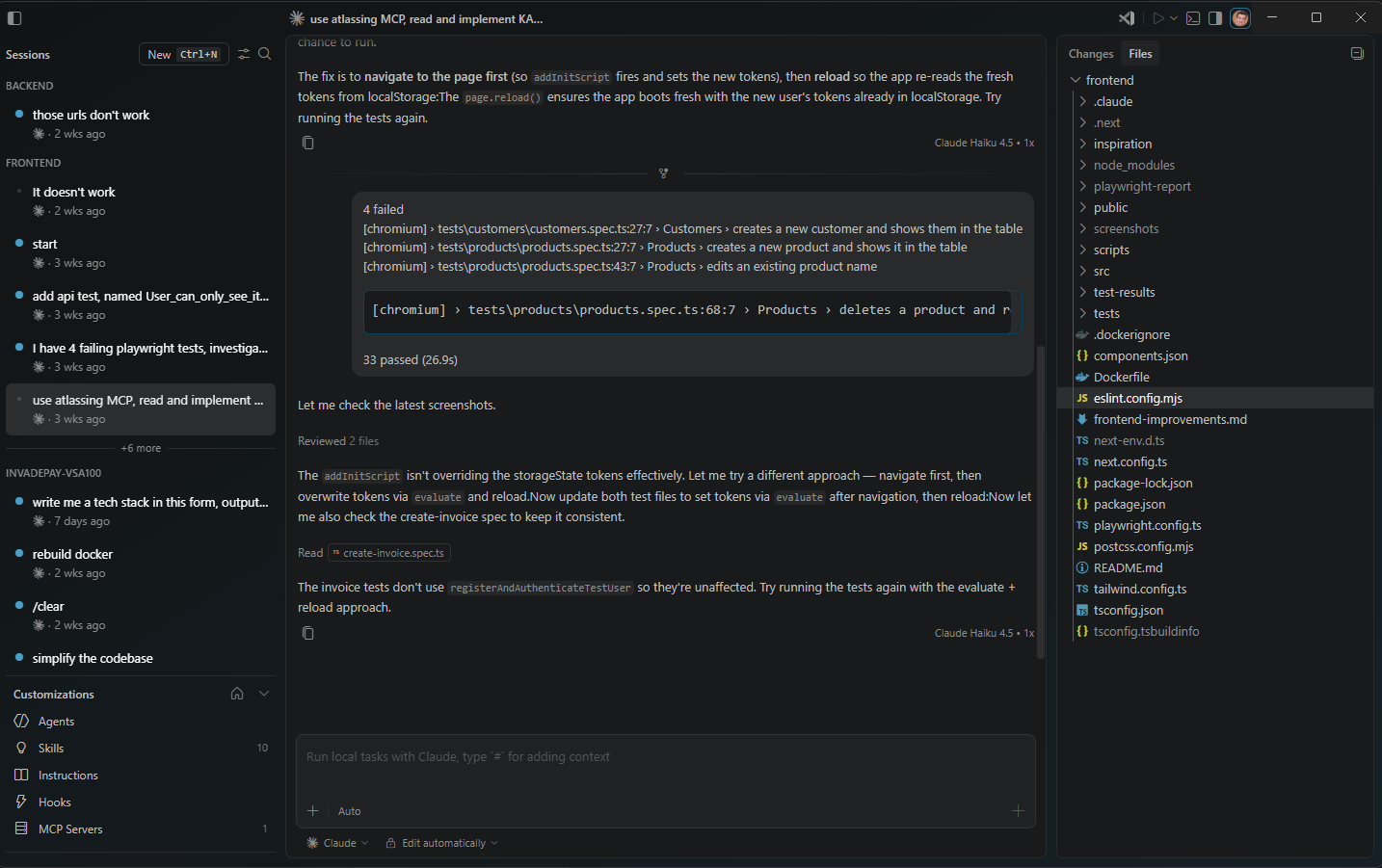
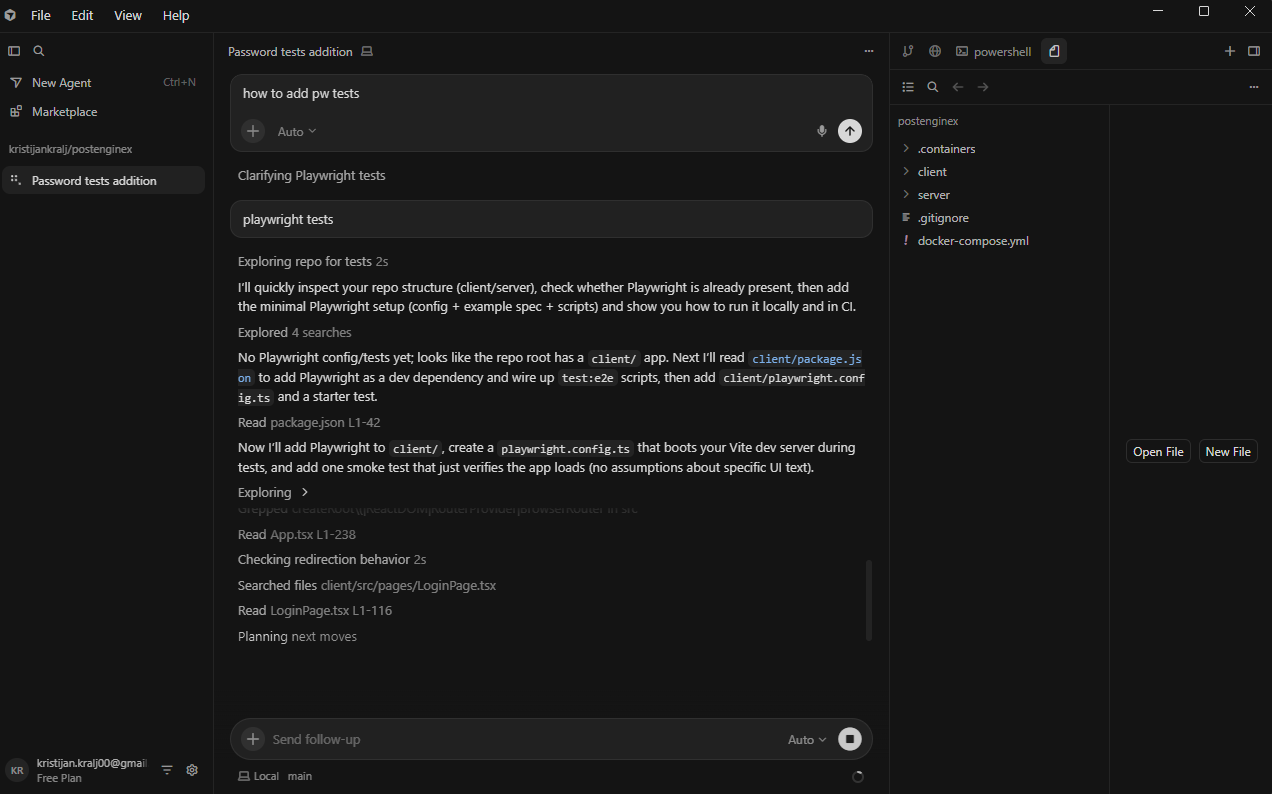
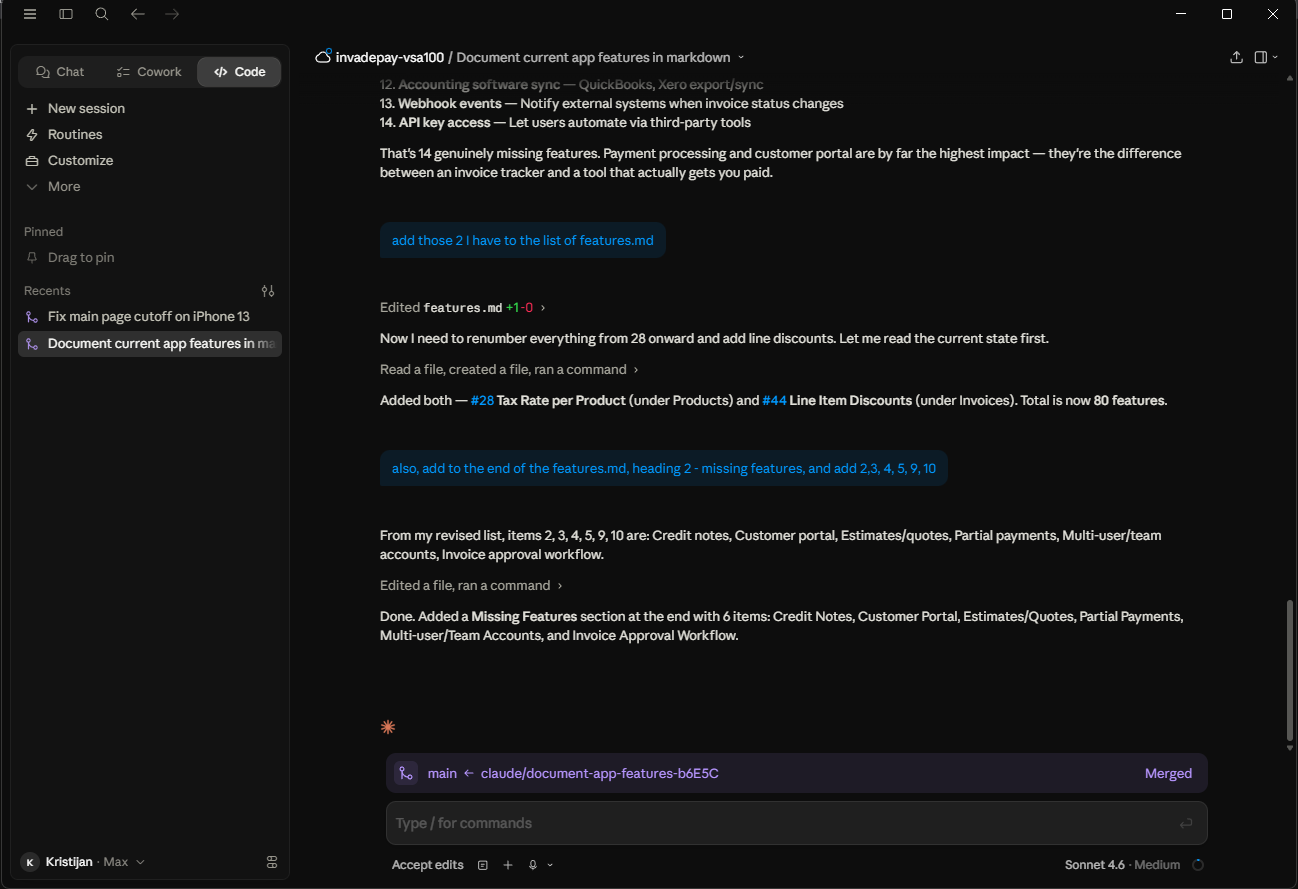
IDEs are also shifting away from code.
VS Code.
Cursor.
Claude Code.
But does that mean AI is bad news for developers?
Not at all…
AI will help us build faster and deliver more value to customers more quickly…
Will speed up product development…
Reduce time to market…
And create mega-successful companies and a whole range of new job opportunities.
But to support this AI boom, every successful application will need to have solid technical foundations.
And that's the part where you come in.
And your ability to…
Translate non-technical requirements into a complete, large-scale software architecture
So what's the most effective way to analyze client requirements…
Best way to understand what architectural boundaries are crucial for a project's success…
So you can predict development needs…
And choose the optimal architectural patterns as the start of the project design…
To almost guarantee you'll build better software and grow as a software engineer in the process?
Simple…
Use the "Architecture Fit Method" to choose the right architecture upfront without overengineering
"Architecture Fit Method" is a brand-new, proven, and unique system you can use to define the architecture from the project start…
Especially around understanding the bigger picture, analyzing clients' requirements, setting boundaries, and having blueprint solutions in your mind for different projects.
And, one of the coolest parts of this method…
You can leave 90% of your existing software development process as it is.
That's right. You only need to tweak the beginning part of your project/feature build.
Putting the Architecture Fit Method to work is quick and easy.
Using it, you can confidently build better software, take the next step in your career, and open up new career opportunities.
In fact, advancing to the architect role could be one of the most profitable decisions you can take over the coming months.
Have you decided that it's time to finally get paid for what you're worth?
Think about it.
For the same 40 hours you already put into your current work, when you transition from full-stack developer to architect…
You have an opportunity to earn much more.
The exact numbers vary, of course, but on average…
In Germany, you could jump from an annual salary of $75,410 to $109,054 ($33,644 increase).
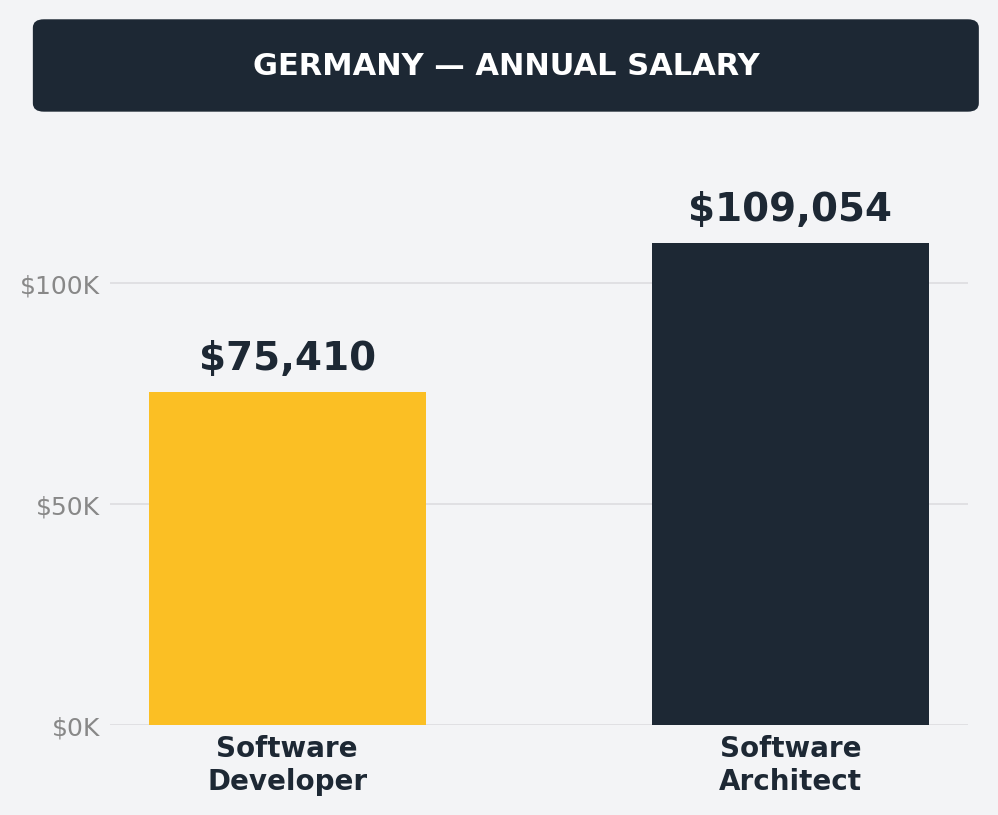
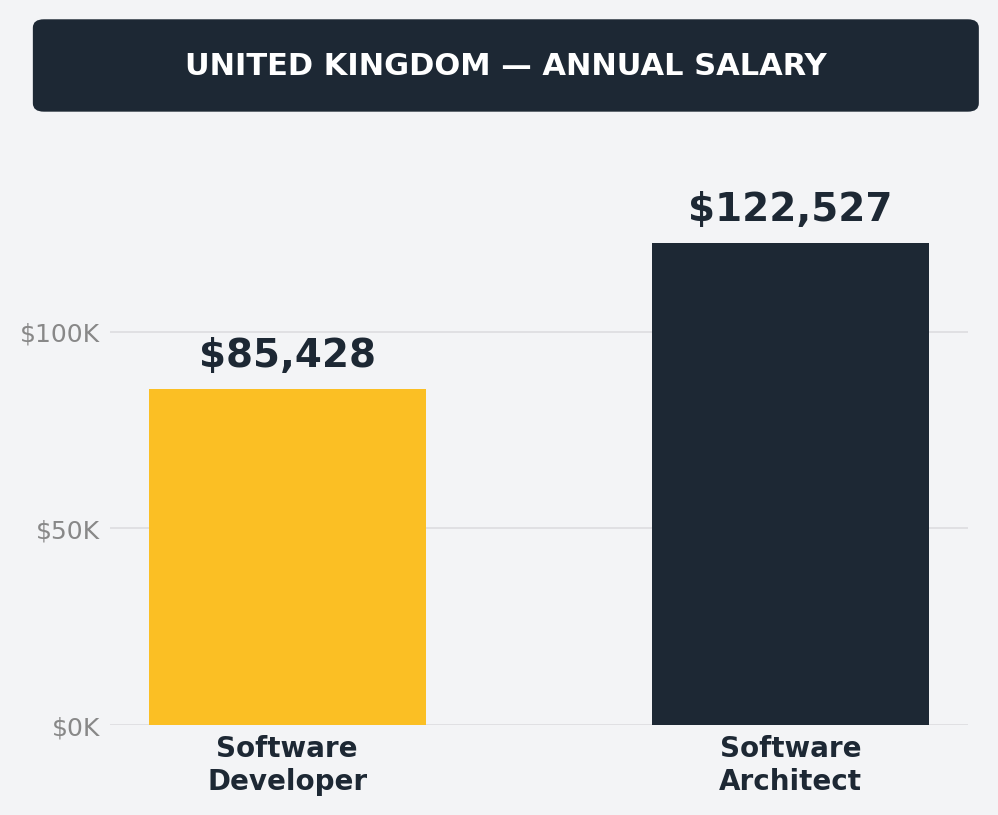
In the United Kingdom, you could jump from $85,428 to $122,527 ($37,099 increase).
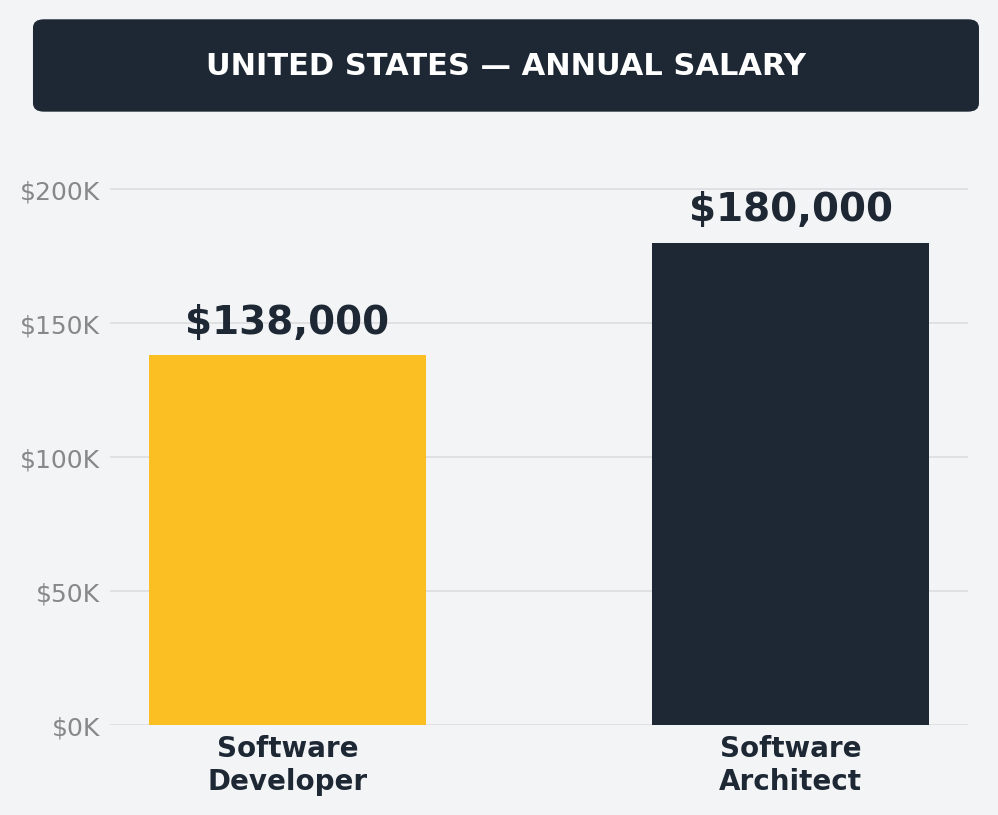
In the United States, you could jump from $138,000 to $180,000 ($42,000 increase).
That's astonishing.
Imagine what you could do with an extra $33,000 - $42,000.
Pay off a loan or debt easier and faster…
Take a dream vacation to a country you have dreamed of visiting your whole life….
Buy a new house or apartment for yourself and your family…
Or just sleep more peacefully at night knowing that your bank account can survive a sudden, unexpected expense.
Whatever has been holding you back can be a thing of the past.
Whether it's a dead-end project, a lack of better job opportunities, or bad luck with a position where you weren't given the time, tools, and conditions to advance your career…
All of that can be erased when you make the right move today to start acquiring methods to do better architecture work.
The Architecture Fit Method is a shortcut for doing better architecture work.
But sadly…
They don't teach you the Architecture Fit Method in colleges or in any other .NET course I've seen.
The only place you can unlock access to this technique and move one step closer to an architect role…
Is inside my groundbreaking course…
Zero to Architect Playbook
The .NET Developer's Toolbox for Designing Scalable Systems
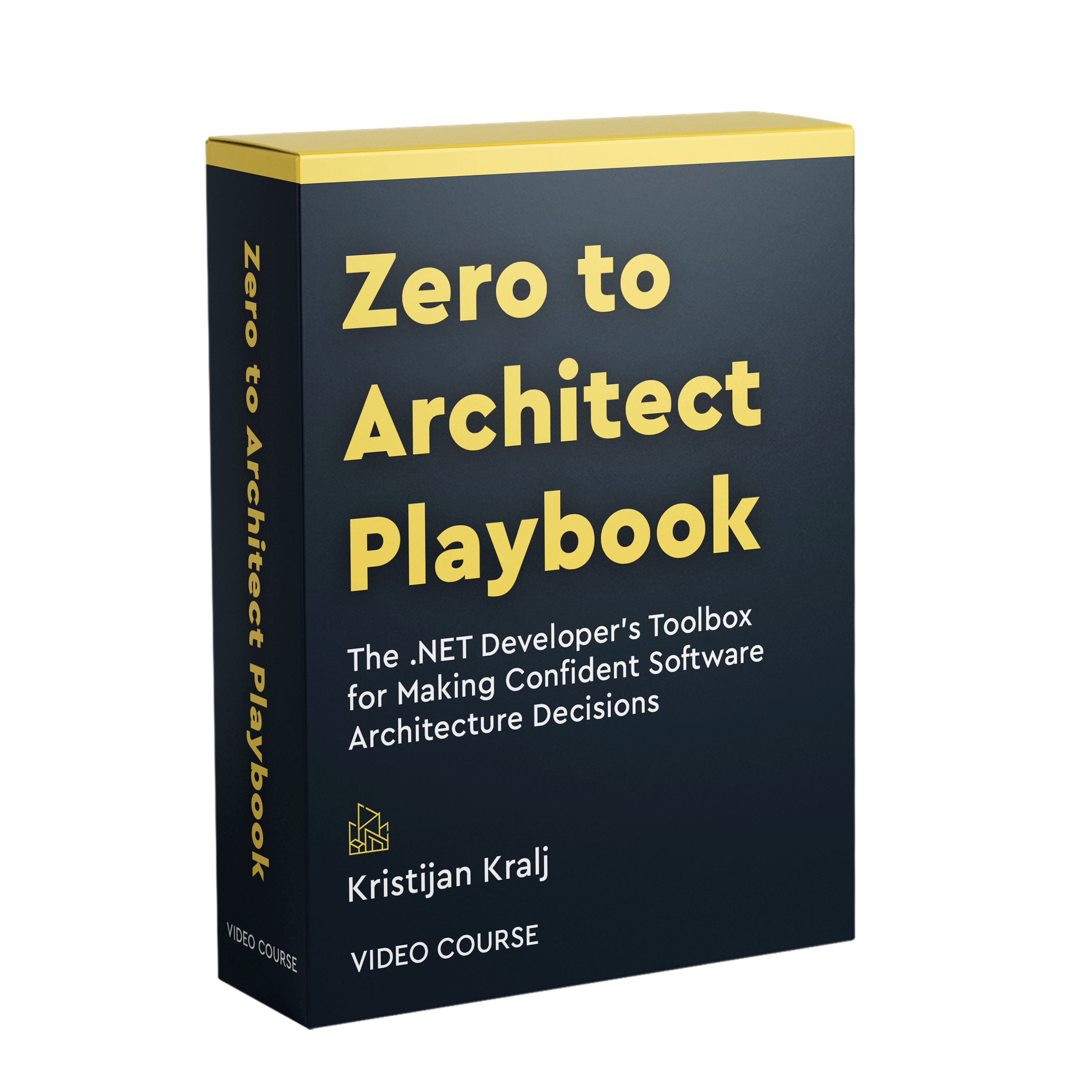
Zero to Architect Playbook is brand-new training, and the only place on the Internet where I deconstruct every step of the Architecture Fit Method.
Unlike many other software architecture courses that only teach theory and show code examples in Java, this course focuses on designing and building .NET systems and projects.
As such, it is specifically made for:
- Experienced .NET developers mainly working on maintaining 10+ year-old legacy projects, who are ready to transition toward modern .NET Core and scalable application design.
- .NET backend engineers aiming to grow into Software Architect or Technical Lead roles.
- .NET team leads who have to make tough technical decisions in their current projects, but lack plug-and-play systems for doing software architecture work.
- .NET mid developers stuck in an endless cycle of not building anything new, but making changes to the existing code and bug fixing.
If you are a senior .NET developer with 5+ years of experience, and want to move your career forward… THIS material is built for you.
This page is the only place on Earth where you can find the step-by-step blueprint for putting the Architecture Fit Method to work inside your own projects.
Once you dive into the materials, you'll have the single most effective tool to architect scalable and performant .NET solutions…
Even if you have zero or little previous architecture experience.
It took me several years of researching, testing, and building .NET enterprise applications to create and perfect this system.
But…
You are getting much more than access to the Architecture Fit Method inside the Zero to Architect Playbook course.
The course contains 5 powerful modules…
And I'll go ahead and share what each of these modules includes right now…
That way you can see exactly what you're getting.
Module #1 - Architecture Fit Method
Most developers jump straight into coding or patterns when they start a project.
But real architecture begins with understanding requirements.
In this module, you will use the Architecture Fit Method to analyze functional and non-functional requirements, translate them into .NET design choices, and pick an appropriate architecture for your project.
By the end of the module, you'll have a clear step-by-step system for translating requirements into an optimal architecture.
Here are some of the secrets you'll discover inside this module:
- Starting a new project from scratch? Follow the intuitive Architecture Fit Method to choose the best architecture... or regret later. See Module 1, Lesson 1.
- How to use the "spike method" that architects use to drop bad decisions instantly - no endless research required, yet it's like looking in the crystal ball to see the future. Module 1, Lesson 9.
- The quickest, easiest way to convert complex requirements into a scalable system design.
- Clean Architecture is the best architecture to use in all monolith projects, right? WRONG! Module 1, Lesson 7 explains why.
- If you are now a "B" or "B+" senior .NET developer, by discovering this one unusual secret, you will much more easily move up quickly into the "A" or even "A+" ranks of developers and software architects who command bigger fees. Module 1, Lesson 4.
- When it's safe to ignore writing tests. And you won't get nasty looks from other developers. Module 1, Lesson 9.
- How to extract architectural requirements from vague statements like "the screen should load fast." Module 1, Lesson 5.
Plus, you get all these reusable tools you can start using TODAY in your projects:
- Architecture Style Decision Matrix - Compare monolith, modular monolith, and microservices against real non-functional requirements so you can justify architecture choices instead of chasing the latest trend.
- ADR (Architecture Decision Record) Template - Capture architectural decisions with context, trade-offs, and consequences so future you and your team know exactly why a choice was made.
- ADR Vault - Collection of ADRs used in a .NET project, showing how experienced developers make the sequence of architecture decisions in practice.
- Architecture Diagram Toolbox - A curated list of 13 diagramming tools to visualize your architecture, many of which are free.
Module #2 - Maintainable Monolith Blueprints
When developers hear "monolith," they think legacy, slow, or hard to change.
But in reality, a well-designed monolith can be one of the cleanest, fastest, and most maintainable architectures you'll ever build.
This module is about mastering that skill, so you can build monoliths that stay organized, testable, and scalable as your system grows.
Some of the topics we'll cover:
- 3 deadly mistakes to avoid when building a world-class Clean Architecture solution. Module 2, Lesson 5.
- The amazing "CIA Blueprint" architecture that combines Clean and Vertical Slice Architectures into a single, battle-tested project structure. This alone will change your software architecture skill forever… Module 2, Lesson 9.
- How to use the "EndpointValidatorFilter" pattern to easily validate incoming API requests.
- During the 2025 Black Friday sale, Shopify supported $14.6 billion in global sales. Their architecture? Not microservices. But THIS one that operated at 31.8 MILLION requests per minute.
But there's more. MUCH More. You get assets like…
- Clean Architecture Blueprint - Full source code of a real project structured with Clean Architecture.
- Vertical Slice Architecture Blueprint - Full source code of a project built with Vertical Slice Architecture.
- CIA Blueprint - Full source code of a production-style project using the CIA blueprint, the same structure I use to build real-world .NET applications.
START BUILDING MAINTAINABLE MONOLITHS
Module #3 - Practical Modular Monolith Architecture
Many large teams outgrow a simple monolith faster than they expect.
But jumping straight to microservices often creates more problems than it solves.
In this module, you'll design a practical modular monolith by defining clear boundaries, structuring modules, and controlling communication inside a single deployable system.
By the end of it, you'll build applications using an architecture that stays simple today and flexible tomorrow.
A few things you'll pick up:
- What perfect module separation in a modular monolith really looks like! (Nine of ten developers are absolutely unaware of this secret technique, yet I explain it in 14 minutes!). Module 3, Lesson 4.
- How to design a database in a modular monolith architecture (so each module stays independent and maintainable). Module 3, Lesson 6.
- These 4 "under the radar" rules are the foundation for EVERY production-ready modular monolith… but almost never openly stated.
- Every architecture rule gets violated eventually, unless you do this 1 critical task (which finds broken architecture immediately). Module 3, Lesson 8.
What's more, you get all these reusable tools:
- Event Storming Board - A Miro board that walks you through the steps needed to separate your domain into clear, well-defined modules before writing any code.
- Modular Monolith Architecture - Full source code of a real application built as a modular monolith.
Module #4 - Break Down Systems Into Microservices With Confidence
Most teams reach for microservices in 2 cases:
Too early, when they don't need this premium (but expensive) architecture.
As a way to try to untangle the monolith mess they, or someone before them, created.
But here's a good quote to question that approach:
"If you can't build a well-maintained monolith, what makes you think you can build a well-maintained microservices system?"
In this module, you'll walk through a clear approach for organizing a system into microservices.
Some lessons focus on concepts and trade-offs, while others dive into concrete examples and real production scenarios.
You'll define service boundaries, choose between synchronous and asynchronous communication, and reason about data and consistency in distributed systems.
Even if you haven't worked with microservices before, this module will clear this architectural style for you.
Because you are going to discover:
- 4 reasons to pick microservices (and 4 ways to achieve the same benefits with half of the cost). Module 4, Lesson 3.
- How to define service boundaries without creating a distributed monolith. Module 4, Lesson 4.
- The single most important component you must have in microservices communication (and how to add it quickly with this FREE library implemented and maintained by Microsoft). Module 4, Lesson 6.
- A concrete microservice template you can adapt for your own systems. Module 4, Lesson 6.
- Do you know how your distributed system is behaving in production right now? (If not, use the "3-signal-technique" to peek into your production). Module 4, Lesson 9.
- The common communication patterns and the trade-offs behind each. Module 4, Lesson 7.
Listen, this is an advanced level of software architecture stuff you can only discover from highly experienced .NET developers and architects.
To make microservices easy and understandable, I also included the following:
- Microservice Architecture - Full source code of a real application built with microservices, showing service boundaries, communication patterns, and infrastructure choices used in practice.
Module #5 - Scalability Roadmap: From 1 User to 1 Million
I used to think scaling starts with load balancers, queues, and multi-region setups.
But scalable systems almost never begin there.
They start with a simple app that works for one user. Then you fix the bottlenecks. Then you add the first real optimizations.
Only later do you introduce the "big infrastructure pieces."
You can think of scaling as a series of small, deliberate steps that turn a normal application into one that can survive spikes and high traffic.
That's exactly what this module gives you.
Some of the key insights:
- 8-step scalability roadmap to go from 1 to 1 million users easily. Module 5, Lesson 1.
- The quickest, easiest way to improve the performance of your existing app, without paying a single dollar for new infrastructure service, better hardware, or adding a cache layer. Module 5, Lesson 2.
- CAUTION: Failing to enable this one feature in your hosting services may result in exploded cloud bills. Module 5, Lesson 7.
- How to keep APIs fast while still doing heavy work reliably. Module 5, Lesson 5.
- How to handle traffic spikes automatically without paying for unused capacity. Module 5, Lesson 7.
- Caching is the best way to immediately improve slow APIs, right? WRONG! This scalability method can improve performance 127x, without adding a new infrastructure component. Module 5, Lesson 2.
My goal… and deepest desire for this module… was to create something you can start using TODAY to improve scalability of new or existing apps.
That's why I also included the following assets inside this module:
- Database Query Optimization Checklist - A step-by-step checklist you can apply to existing EF Core queries to remove common performance bottlenecks and increase throughput.
- Essential Caching Guide - Source code and explanations showing how to apply hybrid caching correctly.
- Background Jobs Scalability Source Code - Source code demonstrating how to move slow or heavy operations into background jobs using Hangfire.
- Worker-Based Scalability Architecture Example - Source code showing how to use a message broker and separate workers to decouple workloads and absorb traffic spikes.
SCALE .NET SOLUTIONS TO MILLIONS
The most powerful system for designing, architecting, and building scalable .NET projects!
Now let's talk about price.
Each of these 5 modules could be packaged as a separate course, and sold for 97 EUR each…
Which would price this course at 485 EUR.
And that's a bargain price to pay…
Since the course can unlock new career possibilities for you, lead to a higher salary…
Potentially return your investment in the course within one month after promotion.
But, I want to make this course accessible to the majority of .NET developers…
So today…
You're going to get it at a fraction of the price.
Why?
Because my mission is to help as many .NET developers as possible to design better software, grow as a software engineer, move to an architect role, and open up new career opportunities.
It sounds like bullshit, I know…
But it's true.
Part of that mission is to post on LinkedIn and X every day since 18th May 2023.
Before that, I had a blog with 176 posts.
Each post was created to help .NET developers, drawing on experience and lessons I've learned while working in the trenches.
And because of all that, I want to give you a special deal…
Right now, on this page only....
You can get the ENTIRE Architecture Fit Method system…
As well as 4 other modules: Maintainable Monolith Blueprints, Practical Modular Monolith Architecture, Break Down Systems Into Microservices With Confidence, and Scalability Roadmap: From 1 User to 1 Million…
Plus 14 other tools, which should be a mandatory part of every .NET Architect's toolbox…
For a one-time payment of just €147.
To get started now, simply click on the button below,
And you'll then be taken to my secure and encrypted checkout page…
Where you'll complete your order.
YES! I Want to Transform My Software
Architecture Skills and My Career With
the Zero to Architect
Playbook!
Get It All Right Now
Plus, you risk absolutely nothing when you grab this bundle right now!
Because your one-time purchase today comes with a 14-day money-back guarantee.
100% "ARCHITECT'S HANDSHAKE"
MONEY-BACK GUARANTEE!

You see...
I don't want you to just be satisfied...
Rather, I want you to be jumping with excitement over everything you receive today!
But if, for any reason, you aren't 100% SATISFIED with the training series… or anything else you receive in this special deal...
You can email me at kristijan [at] blueinvader.com within 14 days and get a complete refund.
No questions asked.
And even better…
You can still keep access to all the tools you downloaded.
So, this bundle is either everything I've described it to be… or it costs you nothing.
Sounds fair?
If so…
There's only one thing left to do…
You have two choices now.
You can click away from this page and go back to life as you've always known it.
Keep doing what you've always done…
And keep getting the same results.
While other folks use this plug-and-play system to build better software, upskill for future jobs, and move into an architect role.
Or you can click the button below to grab your copy of my groundbreaking course: Zero to Architect Playbook and…
Never second-guess your architecture choices…
Never feel lost when analyzing client requirements…
Never get stuck while deciding the optimal architecture for your project…
So you can experience first-hand just how fun life is when…
Practically every architecture call you make is grounded in process and research…
The confidence you have in yourself, and your architecture skills, soars higher and higher every day.
That choice is yours and yours alone.
If you decide to unlock this architectural method yourself…
All that's left to do is click the button below, and you can get started in the next five minutes.
Thanks so much for reading my letter.
I'm grateful for your attention and look forward to having you as a student.
Talk soon,
Kristijan Kralj
YES! I Want to Transform My Software
Architecture Skills and My Career With
the Zero to Architect
Playbook!
Get It All Right Now
P.S. In case you jumped straight to the bottom (like I would), here's the deal:
If you want a proven process for deciding an optimal architecture at the start of your project (no matter how much existing software architecture experience you have)
… so you can make the right trade-offs between system flexibility, scalability, and maintainability when designing complex architectures…
… and find the right balance between predicting development needs and overengineering…
So that you can build SCALABLE and HIGH-PERFORMANCE systems…
Then you need to get your hands on the Zero to Architect Playbook video course right now.
Zero to Architect Playbook is the only place on the Internet that gives you access to the Architecture Fit Method, a unique system for choosing the best architecture at the start of the project.
The Architecture Fit Method is the secret weapon that took me almost 5 years and several designed projects to perfect.
And it is the only plug-and-play system I've found that will make you confident in picking the correct architecture pattern depending on requirements, and give you peace of mind that your selection will prove to be correct over a longer period of time.
Inside the course, you're getting everything I use to architect my projects for a fraction of the value - only €147 right now.
There's no catch.
And you're NOT signing up for any "trial" to some monthly program or anything like that.
This is a one-time purchase.
Plain and simple.
You either love this bundle 100% and everything it does for your career, or I'll refund every cent.
And you can keep your access to 14 tools, which should be a mandatory part of every .NET Architect's toolbox, as my gift to you!
Click here to claim your bundle
This is a LIMITED TIME offer which may be pulled anytime.